Hot Flashes, Thicker Confidence: The Quiet Rise of the Over-50 Chignon
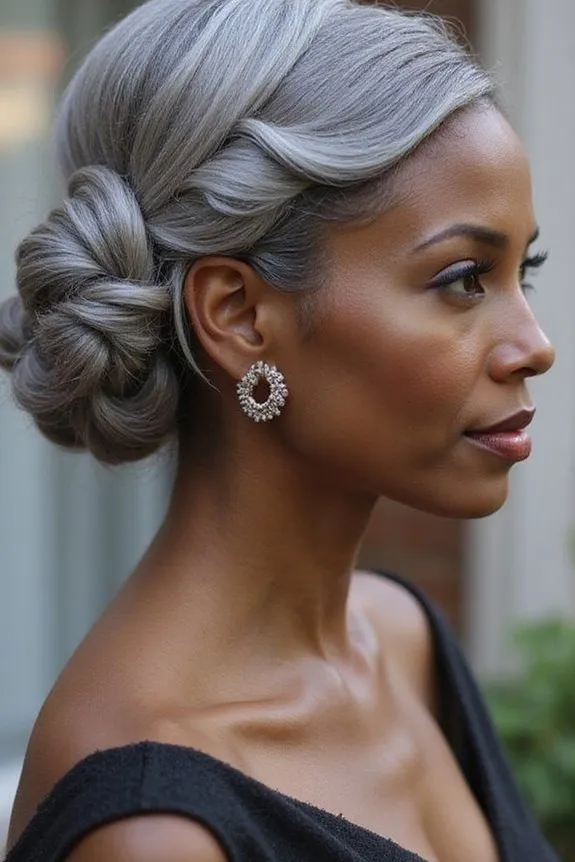
Photo: mature woman over 50 elegant low bun hairstyle salon portrait, via rubystyle.net
Ask around any salon from Scottsdale to Scranton and you'll hear the same quiet confession from women in their fifties: the hair on top isn't what it used to be. Hormonal shifts thin the crown, change the texture, and turn once-reliable blowouts into a daily negotiation. But here's the twist nobody saw coming — instead of hiding it, a growing number of women are gathering it all up. The chignon, it turns out, is having a midlife renaissance.
The Hormonal Hair Reality Nobody Warned Them About
Estrogen has been quietly holding up the scaffolding of women's hair for decades. When it dips during perimenopause and menopause, that scaffolding shifts — density drops at the crown, strands go finer, and the scalp peeks through in photographs for the first time. Dermatologists estimate that more than half of American women experience noticeable hair thinning by the time they reach menopause.
For years, the default response was panic products: thickening shampoos, volumizing mousses, the occasional teary drugstore aisle moment. But a different response has been building in styling chairs across the country. Instead of fighting the hair, women are gathering it — twisting it low, pinning it soft, and calling it a chignon.
"My clients used to apologize when they sat down," says Renata, a stylist with twenty years behind the chair in Portland, Oregon. "Now they say, 'Let's do the bun.' They've decided it's not a compromise. It's the look."
Why the Updo Works With Menopausal Hair, Not Against It
There's real practicality under the pretty. A low, loosely gathered bun does several things at once for changing hair:
- It disguises density shifts. When hair is pulled into a soft twist at the nape, the eye reads shape and polish rather than part-line thinning.
- It buys time between washes. Hormonal changes can make scalps oilier or drier overnight — an updo stretches a blowout gracefully.
- It survives the heat. Ask any woman in a Texas summer: a neck free of hair during a hot flash is not a luxury, it's a survival strategy. Dallas clients literally call it "the neck relief."
- It protects fragile strands. Fine, shifting hair breaks less when it's secured in a loose pin than when it's heat-styled daily.
The technique matters, though. Stylists recommend a loose, slightly undone low bun — think softness at the crown, a gentle tease for lift, and pins rather than tight elastics that stress fragile hairlines. A few face-framing pieces left out soften everything further.
From Cover-Up to Statement
Here's where the story gets interesting. What starts as a workaround often becomes a signature. Women describe the moment the bun stopped being a hiding place and started being a choice — the day they realized the chignon reads as composed, deliberate, even a little French, in the way that a silk scarf does.
Marjorie, 58, a retired school administrator in Georgia, put it plainly: "I fought my hair for three years. Then I pinned it up for my nephew's wedding and my sister said I looked like I had my life together. I don't always, but my hair does."
There's history echoing here, too. The chignon has always cycled through American life as the style of women with things to do — from the Gibson Girl to the working women of the 1970s. Midlife women aren't discovering the updo; they're reclaiming it, on their own terms, with better pins.
The Stylist's Playbook for the Over-50 Chignon
Want to try the look yourself? Working stylists agree on a few ground rules:
- Go low and loose. A nape-level bun flatters every face and puts zero strain on a sensitive hairline.
- Prep with texture, not tension. A light dry shampoo or texturizing spray gives fine hair grip without stiffness.
- Skip the slick. Ultra-tight, pulled-flat styles highlight the scalp. Soft volume at the crown is your friend.
- Invest in good pins. U-shaped and invisible pins hold better than bobby pins on fine hair — and they don't snag.
- Leave a wisp or two. Frame the face. It softens everything and reads effortless.
The whole thing takes about five minutes once you've got the hang of it — which, given everything else on a woman's plate at 50-something, feels about right.
Wearing the Change
Menopause changes a lot of things, and hair is only the most visible. But there's something quietly radical about watching women meet that change with a twist and a pin instead of a fight. The chignon isn't pretending nothing's different. It's saying: this is my hair now, and it looks good gathered up.
As Renata puts it: "The bun isn't hiding anything. It's the most confident thing in my chair."
Pinned, polished, and done by breakfast — that's not a consolation prize. That's the whole point.