Gravity, Humidity, and One Very Determined Veil: The Real Reasons Your Updo Doesn't Survive the Reception
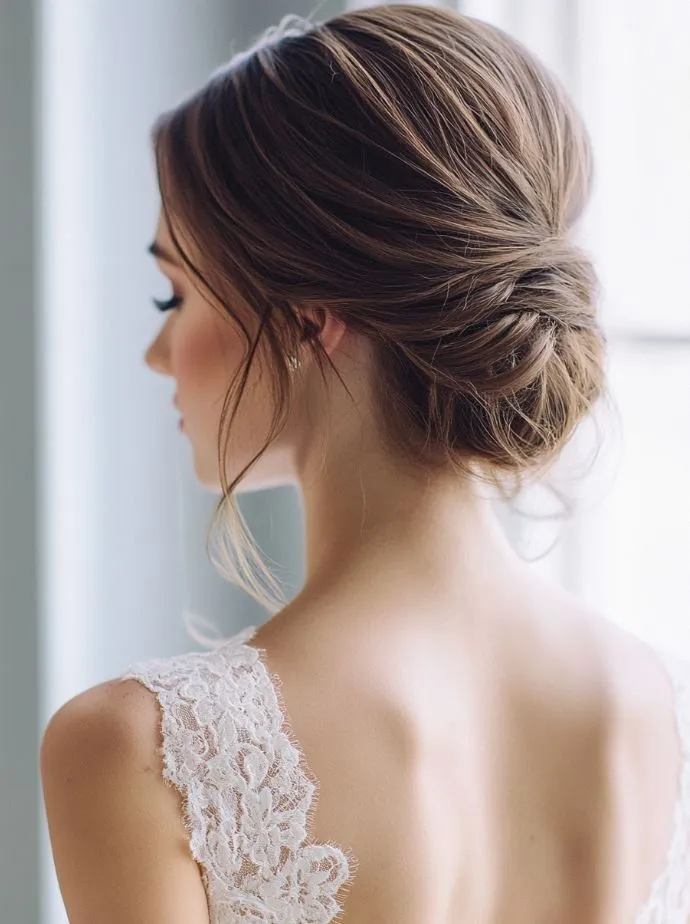
Photo: elegant bridal low bun updo with veil close up, via www.yeahweddings.com
Every bride has heard the warning from some aunt at the rehearsal dinner: honey, that bun won't make it to the cake. And every bride has quietly believed her stylist instead. Then somewhere between the toasts and the electric slide, the low knot that photographed like a dream at first look has sagged into something your cousin politely calls 'undone chic.'
It's not your stylist's fault. It's not your hair's fault, exactly, either. Updo failure is a group project — and the guest list includes chemistry, physics, and one very heavy piece of tulle.
The 80/20 Problem Hiding in Your Hair
Here's the thing almost nobody tells you before the big day: most of what holds an updo isn't the pins. It's the prep. Stylists estimate that setting product, grip, and tension do about 80 percent of the work, and the actual pinning is the finishing touch. Which means a bun that starts life under-built — too little product, hair too freshly washed, tension too gentle — is on a countdown clock from the first hug.
'Clean hair is beautiful hair and terrible scaffolding,' says Dana Whitfield, a stylist in Charleston who does roughly forty wedding updos a season. 'Day-two hair has grit. If a bride shows up with hair I can't grip, I'm building a sandcastle at high tide.'
That grit matters because of a basic material problem: hair is smooth, pins are smooth, and friction is the only thing holding the whole arrangement together. Add oil, conditioner residue, or a generous spritz of shine spray, and you've essentially greased the joints.
Humidity: The Uninvited Plus-One
Hair absorbs moisture from the air — a lot of it. A strand can take on up to a third of its weight in water on a muggy August afternoon, and when it does, the hydrogen bonds inside the shaft that were holding your set in place essentially let go. The hair swells, softens, and reverts to whatever texture it was born with.
This is why a chignon that holds like a fortress in a dryballroom in Denver can dissolve in Houston. Stylists in the Gulf South know this the way farmers know frost dates. Their workarounds are unglamorous and effective: stronger-hold products, more pins than seems reasonable, and sets that are cured under heat so the style has a head start against the weather.
Then there's the venue itself. Outdoor ceremony in July, indoor reception with a packed dance floor — that's a swing from dry heat to body-generated humidity, and your hair experiences both. The most durable updos are planned for the worst environment on the itinerary, not the best one.
Your Veil Weighs More Than You Think
We called a textile engineer to settle a bar-argument question: how heavy is a wedding veil, actually? Answer: a cathedral-length veil with a beaded comb can run close to a pound, and that pound hangs off roughly the same three or four pins holding your bun.
Worse, a veil is a lever. Every time you turn your head, hug a guest, or get pulled into a twirl, that weight pivots against the anchor points, gradually working pins loose the way a door hinge works screws out of a frame. Add a heavy floral piece or a crystal headband and you've multiplied the torque. The fix is unromantic but simple: the veil should be anchored independently — its own pins, its own grip — never hung off the updo itself. Good stylists build a separate attachment point, often a small braided or backcombed base, so the veil's weight has nothing to do with the bun's survival.
Density, Texture, and the Pin Math
Pin manufacturers, for their part, will tell you that most failures are a spec problem. Fine hair needs more pins, not tighter pins — because there's simply less material for each pin to catch. Bobby pins grip hair, and if the hair itself is slippery and sparse, you need a bigger lattice.
Coarse or very thick hair has the opposite issue: it's heavy. A full head of dense hair in a bun can weigh close to half a pound on its own, which is why stylists for thick-haired clients often remove interior bulk or build the style lower, closer to the neck, where the leverage against the scalp is shorter.
And the classic mistake — sliding pins straight in — wastes half their holding power. Pins that cross each other in an X, wicker-like, lock against the hair and each other. It's the difference between Velcro and a hook.
The Diagnostic: What Will Actually Hold for You?
Answer honestly. Your hair and your climate already know.
1. After a shower, your hair air-dries in:
- A) Under an hour, straight as a rule — fine, low-density
- B) A couple hours, some wave — medium density
- C) Forever, and it comes back curlier — coarse or curly, high density
2. Your reception is in:
- A) The humid South or a July tent — plan for moisture
- B) The dry Southwest or a winter ballroom — friction is your friend
- C) A casino in Vegas — all of the above
3. Your accessories:
- A) A cathedral veil plus a statement comb — demand a separate anchor
- B) A few pins or nothing — you have margin
- C) A fresh-flower crown — ask your stylist about the water weight
Your strategy:
Mostly A's: You need grip, not pressure. Ask for day-old hair, a texturizing spray at the roots, and a small, tight bun with plenty of crossed pins. Skip the shine spray until after photos.
Mostly B's: You got lucky, but don't coast. Standard prep works; just make sure the veil or any weight is anchored separately.
Mostly C's: Work with your texture, not against it. A low, deliberately undone style with the natural curl pattern built in will outlast any attempt to smooth it into submission — and it'll look better doing it.
And one rule for everyone, from every stylist we talked to: schedule your trial in the most humid month you can manage, wear it for a full day including a workout, and see what gives. Because the goal was never a bun that never moves. It's a bun that's still there when the song ends.