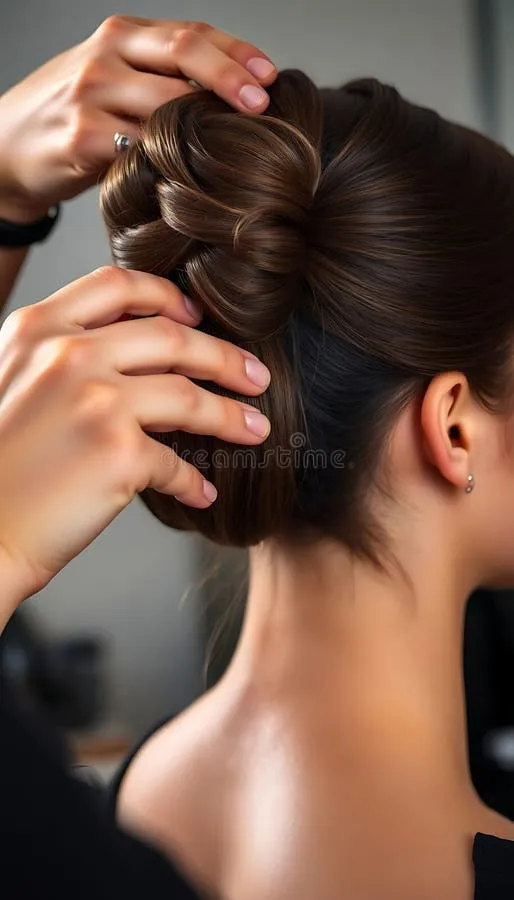
Pinned Under Oath: How Judges, Surgeons, and Anchors Choose the Bun That Means Business

Photo: Shixart1985, CC BY 2.0, via Wikimedia Commons
There's a bun, and then there's the bun.
Ask any stylist who works with surgeons, judges, or evening news anchors, and they'll tell you the difference in about four seconds flat. The first is a hairstyle. The second is a piece of professional equipment — pinned, smoothed, and calibrated to communicate one thing: I am not distracted, and neither are you.
We spent weeks talking to stylists from Cleveland to Dallas who count litigators, anesthesiologists, and broadcast journalists among their clients. What we learned is that America's most serious rooms have quietly developed a whole grammar of updos — and the women in them know exactly which sentence they're trying to say.
The Two-Inch Rule
Ask about height and every stylist we spoke to converged on the same number, give or take an inch.
"Nothing above the occipital bone for my clients in the courtroom," says a stylist in Columbus who books three judges and a rotating cast of trial attorneys every week. "A high bun reads youthful, editorial, maybe a little fun. My clients can't risk 'fun.' A low, dense bun at the nape reads settled. It reads final ruling."
The logic tracks with what we already know about the chignon's long American reign: the lower the bun, the calmer the signal. A crown-height topknot says you're headed to brunch. A nape-grazing knot says you've read the briefs.
Tightness Is a Love Language
Here's where it gets slightly counterintuitive. The women in the highest-stakes rooms don't want soft and romantic. They want secure.
"My OR clients — surgeons especially — are underneath a cap for hours," one Dallas stylist explains. "If a pin shifts, that's all they're thinking about while they're holding a clamp. So we build for compression. Everything slicked, everything anchored, nothing that moves."
The result is less a style than a containment strategy. Gel, smoothing cream, a fine-tooth comb, and enough pins to set off a detector — the finished look is glossy and severe, and that severity is the point. A flyaway in the O.R. hallway reads as chaos. A flyaway in front of a jury reads as doubt.
Shine: The Undercover Variable
If height and tightness are the rules everyone intuits, shine is the one stylists obsess over that clients rarely articulate.
"Studio lighting is brutal," says a stylist who preps local news anchors before their 4 p.m. taping. "A matte bun disappears under key light. A slightly glossy bun gives the camera something to read as polished — even from a distance, even on a small screen." Too much shine, though, and you tip from polished into greasy, which is why her kit includes a light-reflecting spray used the way you'd use seasoning: a whisper, never a pour.
In the courtroom, the calculus flips. Overhead fluorescents flatter no one, so litigators tend to go matte and matte again — texture spray, dry shampoo, anything that keeps the hair from gleaming under the kind of light that makes everyone look slightly under investigation.
The Wrong Bun Is a Quiet Tax
Nobody gets fired over a messy bun. But stylists describe a cumulative cost — a low hum of distraction, a comment from a colleague, a juror's raised eyebrow — that serious professionals would rather never pay.
"One of my clients, a litigator, told me she lost her train of thought mid-argument because she caught her reflection and saw a piece of hair sticking out," the Columbus stylist recalls. "After that, she booked standing appointments. She said the updo wasn't vanity. It was removing one variable."
That framing comes up again and again: the authority updo isn't about looking beautiful. It's about elimination. No bounce, no frizz, no strand out of formation — nothing for the room to look at except the work.
The Anchor's Dilemma
Broadcast talent face a wrinkle nobody else does: the earpiece. Hair has to be built around hardware — the bun positioned to sit clear of the receiver, the pins placed to avoid pressure points during a three-hour broadcast.
"I've essentially engineered load-bearing buns," the news-stylist admits. "There's a channel for the wire, a counterweight on the opposite side, and a finishing spray that can survive hot studio lights for six hours. It's architecture."
What the Rest of Us Can Steal
You may never argue a motion or hold a scalpel, but the principles translate beautifully:
- Go lower than feels natural. The nape bun is the little black dress of updos for a reason.
- Anchor like you mean it. Cross two pins in an X at the base, then add two more for insurance.
- Match your shine to your lighting. Gloss for camera, matte for fluorescent overheads.
- Build for the duration. Think about how many hours you need — then add two.
The women in America's most serious rooms figured out something the rest of us can borrow for free: a great updo doesn't ask for attention. It clears the way for it.
And that, more than any pin count, is what makes a bun look like it means business.